
Checking for a Warrant in St. Louis
Grab the citation or case number first, then call the court holding the file. The St. Louis Police Department posts no warrant list. No roster exists for any city in the county either. Only the 65B District Court can confirm a St. Louis warrant.
- Read the citation or court notice for the case number.
- Search MiCOURT by last name to find the St. Louis case.
- Call 65B District Court at 989-875-5240 about the warrant.
- Call St. Louis Police at 989-681-5285 about a report or service.
- Speak with a lawyer before acting on a confirmed warrant.
Note: A city police contact can confirm a report or an arrest, but only the court can confirm or withdraw a warrant.
St. Louis Police as the Local Warrant Contact
You will find the St. Louis Police Department at 300 N Mill Street in St. Louis. Call 989-681-5285 or fax 989-681-4620. Office hours run 8:00 a.m. to 4:00 p.m., with the department describing 24-hour police coverage for the city. For non-emergencies, Gratiot Central Dispatch answers at 989-875-7505. Emergencies go to 911. Dispatch routes calls; it is not a records desk. The St. Louis Police Department page lists the same details.
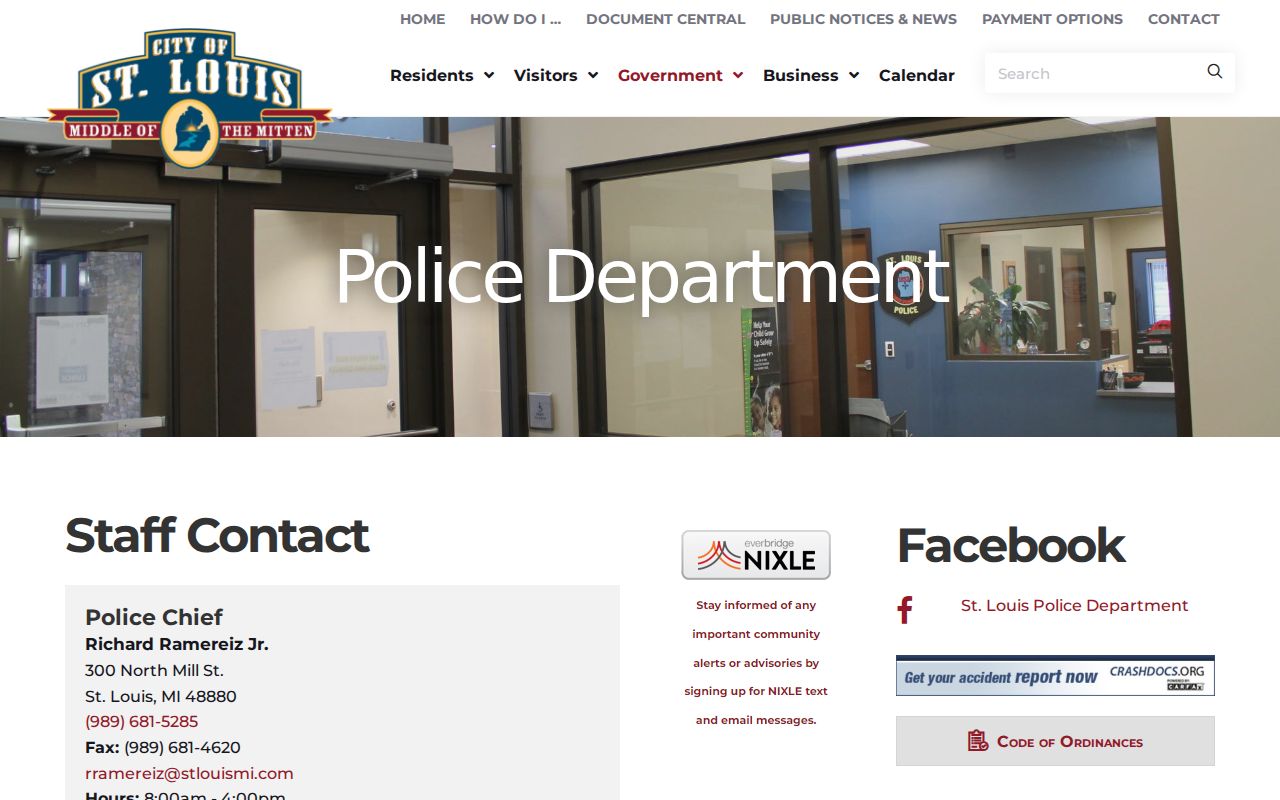
The police page posts the address, phone number, and coverage statement that residents ask about most.
St. Louis Police and Municipal Court
St. Louis has no municipal court of its own. The official Gratiot County court map shows one limited-jurisdiction court, 65B, and it handles St. Louis cases along with the rest of the county. City ordinance matters and state traffic tickets land there too. If a search turns up a St. Louis municipal court online, it belongs to another state or to a directory guessing wrong. Send every city case question to 65B.
Why St. Louis Warrant Checks Still Go to 65B
Around-the-clock coverage is not a warrant database. Officers can run a person through the state system during a stop. The public cannot. That access stays with law enforcement, and the department does not share it. What a St. Louis resident can do is ask the court. The District Court holds the record, sets the bond, and explains what the judge requires. A call to police about a court order usually ends as a referral to that same court.
St. Louis Warrant Types
Four kinds of orders can reach a St. Louis resident. Each one starts somewhere different, so the type decides which office to call first.
| Warrant Type | How It Arises | Who Issues It |
|---|---|---|
| Traffic or civil infraction | A missed St. Louis or state traffic date | 65B District Court |
| Ordinance violation | An unresolved city code matter | 65B District Court |
| Bench warrant | A missed court date in a city case | The judge on the case |
| Arrest warrant | A complaint and probable cause after an investigation | Magistrate or judge |
St. Louis Warrant Records Versus City Records
A police incident report and a court warrant record are not the same document. The city keeps the report. The court keeps the case file. The two may not even match on the same day. Ask which one you need before filing a request, since a city administrative record goes through the county FOIA process while a court file follows the court's own access rules.
Inside a St. Louis Warrant Record
Once a St. Louis matter reaches the court, the record uses the court's identifiers. The city name shows up only as the originating agency.
| Case Number | The 65B identifier, for example 2025-002987-TR. |
|---|---|
| Originating Agency | St. Louis Police Department or the city code office. |
| Charge | The ordinance section or the state offense involved. |
| Issuing Court | 65B District Court for city matters, or the 29th Circuit for a felony file. |
| Status | Open, paid, warrant issued, or warrant recalled. |
When a St. Louis Warrant Follows a Ticket
A St. Louis traffic ticket belongs to the District Court. You get fourteen days to pay or enter a plea. Miss that window and the court can issue a bench warrant. The police department has no say in that process. Call 65B at 989-875-5240 and follow the traffic prompts. The clerk can pull the case, explain what is owed, and say whether a warrant is open.
How St. Louis Warrants Fit the County System
A St. Louis case travels the same route as any Gratiot County matter. Police investigate. The prosecutor reviews. Then a judge decides between a warrant and a summons, and the clerk enters the result.
Warrant flow: St. Louis Police or city code › 65B District Court › 29th Circuit Court for felony matters › county jail after an arrest.
For countywide detail, the Gratiot County warrant records overview covers the Sheriff's role and the FOIA route.
St. Louis Size and the Shared Warrant Court
St. Louis counts 7,010 residents in the 2020 Census, making it the second-largest incorporated city in Gratiot County. Alma is bigger; Ithaca, the county seat, is smaller. All three share one court system. That sharing is why a St. Louis case can be heard in Ithaca. The city keeps its own police and municipal services, while court work stays countywide.
St. Louis Warrant Records and Public Access
Michigan separates court access from county records access. Court files stay open unless a rule or order restricts them. County and city administrative records run through the Freedom of Information Act instead. Some court records stay closed by design.
Key Rules:
MCL 15.231 et seq. - the Michigan Freedom of Information Act covers city and county record requests.
MCR 8.119 - court records are open unless a rule, statute, or order restricts them.
MCL 780.651(8)-(9) - a search warrant affidavit stays nonpublic until the 56th day unless the court orders otherwise.
St. Louis Warrant Information the City Does Not Publish
The official St. Louis city police page offers a contact block, a coverage statement, and public-safety resources. It publishes no warrant search, no warrant phone line, no most wanted list, and no court lookup. One link points to a state offender registry, a separate resource and not a warrant tool. A blank city page proves nothing about a court case. Confirm with 65B rather than trusting a web result. The City of St. Louis official site is the starting point for city records.

The city site posts department contacts and building information, which is where any St. Louis record request begins.